
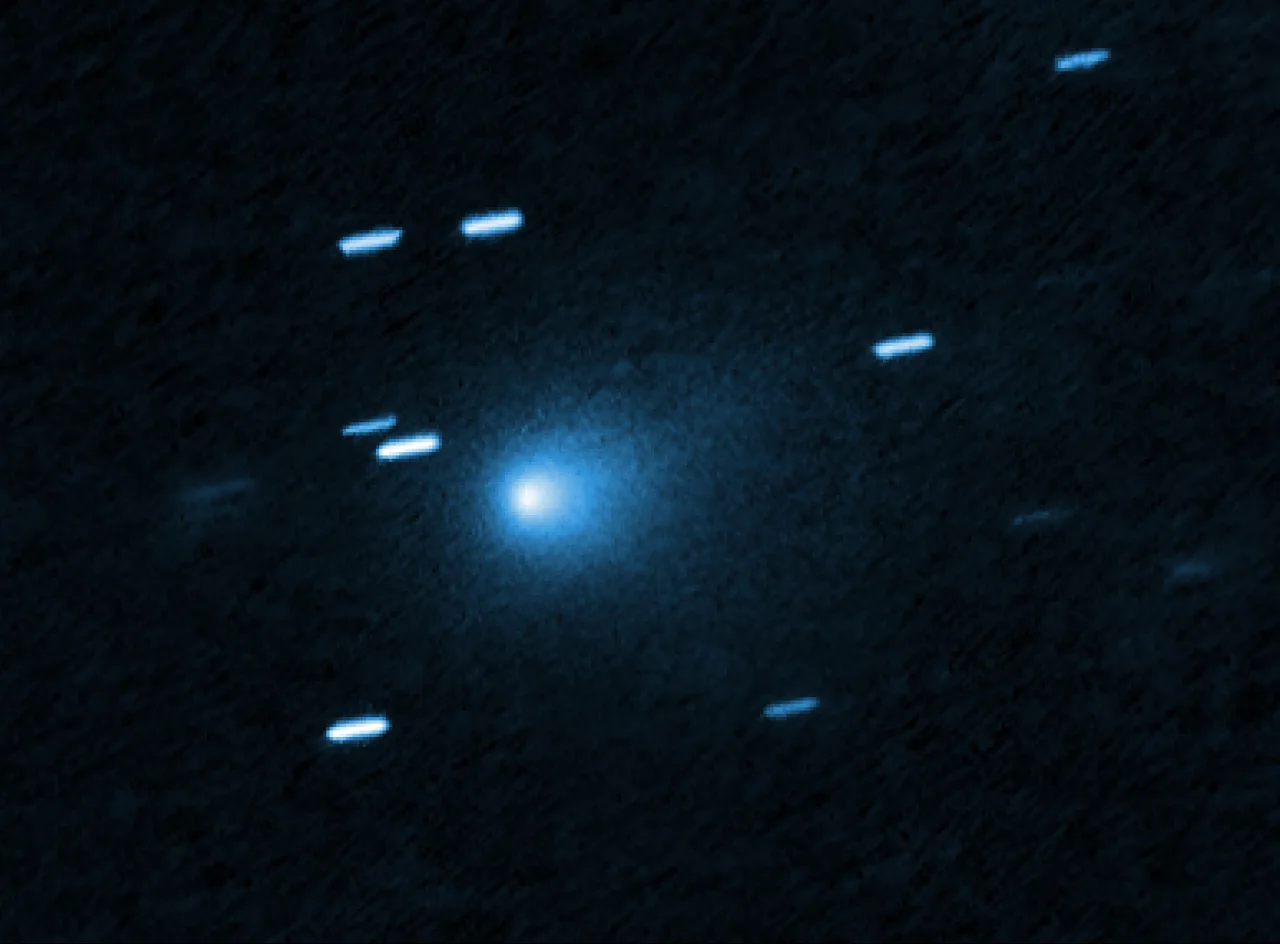
There is something extraordinary about looking at a comet and realizing it does not belong to our Solar System.
Most comets are distant relatives of Earth. They formed from the same ancient cloud of gas and dust that gave birth to the Sun, planets and moons some 4.6 billion years ago. Even when they spend millions of years in the darkness, they remain part of our cosmic family.
3I/ATLAS is different. It arrived from interstellar space, followed a path through our planetary neighborhood and is now heading back out. Whatever star system first shaped its ice, it was not ours.
And new science has made this visitor even more intriguing. A study published in Nature Astronomy on October 23, 2026, reports that methane released by 3I/ATLAS contains an astonishing amount of deuterium, a heavier form of hydrogen. Together with earlier measurements of its water and carbon, that chemical fingerprint points toward a birthplace far colder, and potentially far older, than the environment in which our planets formed.
One interpretation suggests that parts of this comet's history could reach back as far as 12 billion years. That is not a measured birthday. It is a striking possibility emerging from the chemistry of an object we were never supposed to meet.
A discovery that changed the visitor list
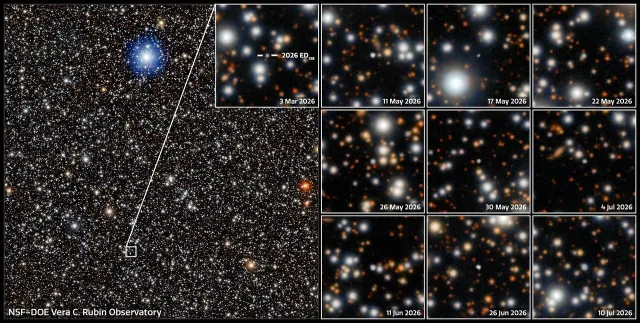
On July 1, 2025, the ATLAS survey telescope in Chile reported a moving object to the Minor Planet Center. ATLAS, short for Asteroid Terrestrial-impact Last Alert System, normally helps astronomers discover and track objects moving through the sky. This time, the orbit was the real story.
3I/ATLAS was not following the kind of elongated but closed path that brings familiar comets back around the Sun. Its orbit was hyperbolic. Even accounting for the Sun's gravitational influence, it was moving too fast to be a permanent member of our Solar System. Trace its path backward and it comes from interstellar space. Trace it forward and it escapes again.
The name tells the story. The number 3 means it is the third confirmed interstellar object ever detected, following 1I/ʻOumuamua in 2017 and 2I/Borisov in 2019. The I stands for interstellar, and ATLAS identifies the survey that discovered it.
Three detections are not much of a census. Astronomers suspect that countless fragments are drifting between stars, expelled from young planetary systems or scattered by giant planets. Finding them is difficult. They are small, usually dark, and most become noticeable only when they pass comparatively close to the Sun.
For a brief interval, 3I/ATLAS gave us an opportunity to examine matter made somewhere else in the Galaxy.
The Sun switched on a chemical laboratory
As 3I/ATLAS approached the Sun, its frozen materials began turning directly into gas, a process called sublimation. Escaping gas carried dust away from the solid nucleus and created the diffuse cloud astronomers call a coma. Sunlight and the solar wind helped shape the comet's tails.
This activity was useful for an unexpected reason. We cannot simply collect a piece of 3I/ATLAS and bring it into a laboratory on Earth. But as the comet releases gas, its molecules leave distinct spectral signatures. Powerful telescopes can separate the light into wavelengths and identify some of the substances present, even from enormous distances.
The comet passed closest to the Sun around October 29–30, 2025, at roughly 1.4 astronomical units, about 210 million kilometers. It never threatened Earth. At its nearest, it remained approximately 270 million kilometers from our planet.
Around that passage, ground-based telescopes and spacecraft observed its activity. Hubble studied its dusty coma. The James Webb Space Telescope examined the gases. ALMA, the huge radio telescope array in Chile, measured chemical signatures that optical images cannot reveal. Other missions, including spacecraft observing from the vicinity of Mars and ESA's Juice probe, supplied different viewing angles.
The result was much more than a pretty comet photograph. It was an unusually detailed look at the ingredients of a planetary system beyond our own.
What Webb found inside the methane
The latest clue came from methane. Methane is a simple molecule built from one carbon atom and four hydrogen atoms. It is not, by itself, evidence of life. In space, it can form through entirely nonbiological chemical processes.
But not all hydrogen atoms are identical. Most contain one proton in their nucleus. Deuterium contains a proton and a neutron, making it heavier. Under certain very cold conditions, chemical reactions can preferentially incorporate deuterium into molecules. The ratio of deuterium to ordinary hydrogen, written D/H, can therefore preserve clues about the environment in which those molecules formed.
Using near-infrared observations from Webb, researchers measured a methane D/H ratio of 3.18 ± 0.30 percent in 3I/ATLAS. The result, published on October 23, 2026, is remarkable: it is approximately 13 times the ratio measured in methane from comet 67P/Churyumov–Gerasimenko, the Solar System comet investigated by ESA's Rosetta mission.
That does not mean the comet is 13 times richer in methane, or that 3 percent of the entire object consists of heavy hydrogen. It refers specifically to the ratio of hydrogen isotopes within the methane detected in its surrounding gas.
The researchers interpret this unusual enrichment as consistent with ice chemistry in an extremely cold, relatively metal-poor environment that experienced substantial cosmic-ray irradiation. In astronomy, metal-poor means an environment containing relatively fewer elements heavier than helium. It does not mean there was no metal at all.
The finding is one more clue that 3I/ATLAS was assembled under conditions quite unlike those of many comets born around our Sun.
Water that remembers a different sky
Methane is only part of the picture. In June 2026, a study published in Nature reported exceptional isotopic signatures in water and carbon-bearing molecules released by 3I/ATLAS.
Its water had a measured D/H ratio of approximately 0.98 percent, more than an order of magnitude above values found in known Solar System comets. Its carbon isotope ratios were also unusual. Together, those measurements pointed to an environment potentially colder than 30 kelvin, about minus 243 degrees Celsius.
That temperature is not a reading taken by a thermometer on the comet today. It is an inference about the conditions under which some of its material may have formed, long before the object passed our Sun.
Think of the ice as a record rather than a clock. The proportions of different isotopes carry information about the chemistry of an ancient cloud or disk. Scientists then compare those measurements with models of how stars, gas and heavy elements changed over the history of the Milky Way.
The result is not a street address for the comet's birthplace. It is a set of clues narrowing the kinds of places where that birthplace might have existed.
Could this comet really be 12 billion years old?
Here is the astonishing possibility.
Our Sun formed about 4.6 billion years ago. The Universe itself is approximately 13.8 billion years old. If a model placing the formation of 3I/ATLAS around 12 billion years ago is correct, some of its material could have been assembled when the Milky Way was far younger and our Solar System did not yet exist.
That would make it less like a visitor from the neighboring street and more like a fragment from a very early chapter of galactic history.
But the important word is if. The proposed age comes from interpreting isotopic ratios through models of galactic chemical evolution. It is not a direct radiometric age measurement, and it does not identify the particular star around which 3I/ATLAS formed. Different formation histories remain possible. Following an object backward through billions of years of gravitational encounters is not something astronomers can do with certainty.
The honest finding is already extraordinary enough: several independent chemical measurements are consistent with a very cold, chemically distinct origin, possibly in an ancient stellar environment.
We do not need to turn a compelling scientific hypothesis into a certainty to appreciate it.
Alien chemistry, familiar ice
There is another beautiful twist. A study announced by the Southwest Research Institute on October 26, 2026, used Webb observations to examine tiny ice grains escaping from 3I/ATLAS. The grains appear to be minute aggregates of water ice and dust, about a micrometer or smaller. Their spectral features differ from those of ice in many previously studied comets, yet resemble some icy material found in the outer Solar System beyond Neptune.
That combination is fascinating. The comet's isotope ratios suggest a very different chemical history, while some of its tiny grains show physical similarities to the icy building blocks we know closer to home.
In other words, planetary systems can have different histories without obeying completely different laws. Ice, dust, radiation and gravity shape worlds everywhere. The recipes may change, while some ingredients remain surprisingly familiar.
That is why interstellar objects are so valuable. We cannot travel to most other planetary systems. Occasionally, however, a piece of one travels through ours.
Is 3I/ATLAS something artificial?
Its unusual orbit and chemistry have also inspired speculation about extraterrestrial technology. Extraordinary ideas attract attention, especially when the object has come from beyond the Solar System.
But an interstellar origin is not evidence of engineering. 3I/ATLAS has shown the coma, escaping gases, dust and molecular signatures expected from an active comet. Scientists can investigate unusual behavior without assuming it has an artificial cause.
Researchers at the SETI Institute even searched for radio signals that might indicate technology associated with 3I/ATLAS. Their reported observations found no evidence of extraterrestrial transmitters in the frequencies and sensitivity ranges they examined. That result cannot exclude every imaginable possibility, but it does not support the claim that the comet is a spacecraft.
The genuinely surprising story is the one supported by observations: we may be seeing frozen material assembled around a star whose history is profoundly different from our Sun's.
A message we can read, but cannot keep
3I/ATLAS is leaving. Its open trajectory means it is not a periodic comet that will return for another close pass in a few decades. Its encounter with the Sun has given researchers a window into its chemistry, and that window is gradually closing as the object heads back into the darkness between stars.
Astronomers will continue analyzing the observations already collected. Spectra are rich with information, and sometimes the most important discovery comes months after the photons have reached a telescope's detectors. New surveys are also expected to find more interstellar visitors, giving scientists a chance to compare one alien comet with another rather than treating every arrival as an isolated mystery.
There is a quiet perspective shift in all of this. The Solar System once felt like our entire neighborhood. Today, telescopes can watch fragments of other planetary systems cross its borders. A faint patch of light can reveal the chemistry of a star system we may never identify, and perhaps a history much older than Earth.
For a moment, an object that belonged to another sky became part of ours.
3I/ATLAS will not stay. But the clues it leaves behind could change how we understand the worlds that form around other stars.