


Far beyond Pluto, astronomers have found a world that may have been hiding in plain sight for years.
Its provisional name is 2026 ED138, and it could be one of the largest dwarf planets discovered in the outer Solar System.
But what makes this discovery particularly remarkable is not just the object's size or distance.
It's where it was hiding, and how scientists finally found it.
A mysterious world beyond Pluto
On October 27, 2026, the NSF–DOE Vera C. Rubin Observatory announced the discovery of 2026 ED138, a large trans-Neptunian object orbiting the Sun beyond Neptune.
The object is currently approximately 46 astronomical units from the Sun, meaning it is about 46 times farther away than Earth, or nearly 7 billion kilometers from our star.
For comparison, Pluto's average distance from the Sun is approximately 40 astronomical units.
Researchers estimate that ED138 could measure between 600 and 1,500 kilometers in diameter.
That is a remarkably wide range, but there is a reason for the uncertainty.
Astronomers can measure how bright a distant object appears, but brightness alone cannot reveal its exact size. A smaller, highly reflective world can appear just as bright as a larger, darker one.
Until scientists determine how much sunlight ED138 reflects, its true diameter will remain uncertain.
How did such a large object remain undiscovered?
The answer lies in one of the most crowded regions of our night sky.
ED138 was found close to the apparent plane of the Milky Way, where enormous numbers of distant stars fill the background.
To an ordinary telescope image, the object looks like another faint point of light surrounded by countless others.
Unlike the background stars, however, ED138 slowly changes position as it moves around the Sun.
On October 13, astronomer Matthew Holman identified the object while analyzing observations collected earlier in 2026 by Rubin Observatory.
The discovery relied on software developed with astronomer Kevin Napier, designed to connect detections of moving objects across enormous collections of astronomical data.
Once the candidate was identified, researchers searched additional observations and discovered something surprising.
The object had already been photographed many times.
Rubin Observatory had recorded it on 20 separate nights between March and July 2026. Even older images from the Dark Energy Camera revealed observations dating back to 2016.
In other words, evidence of this distant world had been sitting in astronomical archives for roughly a decade.
Nobody had previously recognized it as the same moving object.
Is 2026 ED138 officially a new planet?
Not yet, and there is an important distinction.
2026 ED138 is currently classified as a dwarf planet candidate, not a confirmed dwarf planet or a ninth major planet.
According to the International Astronomical Union, a dwarf planet must have enough mass for gravity to pull it into a nearly round shape, while not having cleared its orbital neighborhood of other objects.
The Solar System currently has five officially recognized dwarf planets: Ceres, Pluto, Haumea, Makemake and Eris.
ED138 may eventually join that group.
Objects of its estimated size are expected to be approximately round, but additional observations are necessary to establish its physical characteristics.
And despite headlines about a new world beyond Pluto, this is not a discovery of the hypothetical Planet Nine. ED138 is a much smaller type of object belonging to the known population beyond Neptune.
Why this discovery matters
The outer Solar System is not an empty region beyond the familiar planets.
It contains countless icy bodies, remnants of the Solar System's formation approximately 4.6 billion years ago.
Studying their sizes, compositions and orbits provides clues about how the giant planets migrated and how gravitational interactions reshaped the early Solar System.
ED138 follows an inclined orbit, tilted by roughly 24 degrees relative to the main planetary orbital plane.
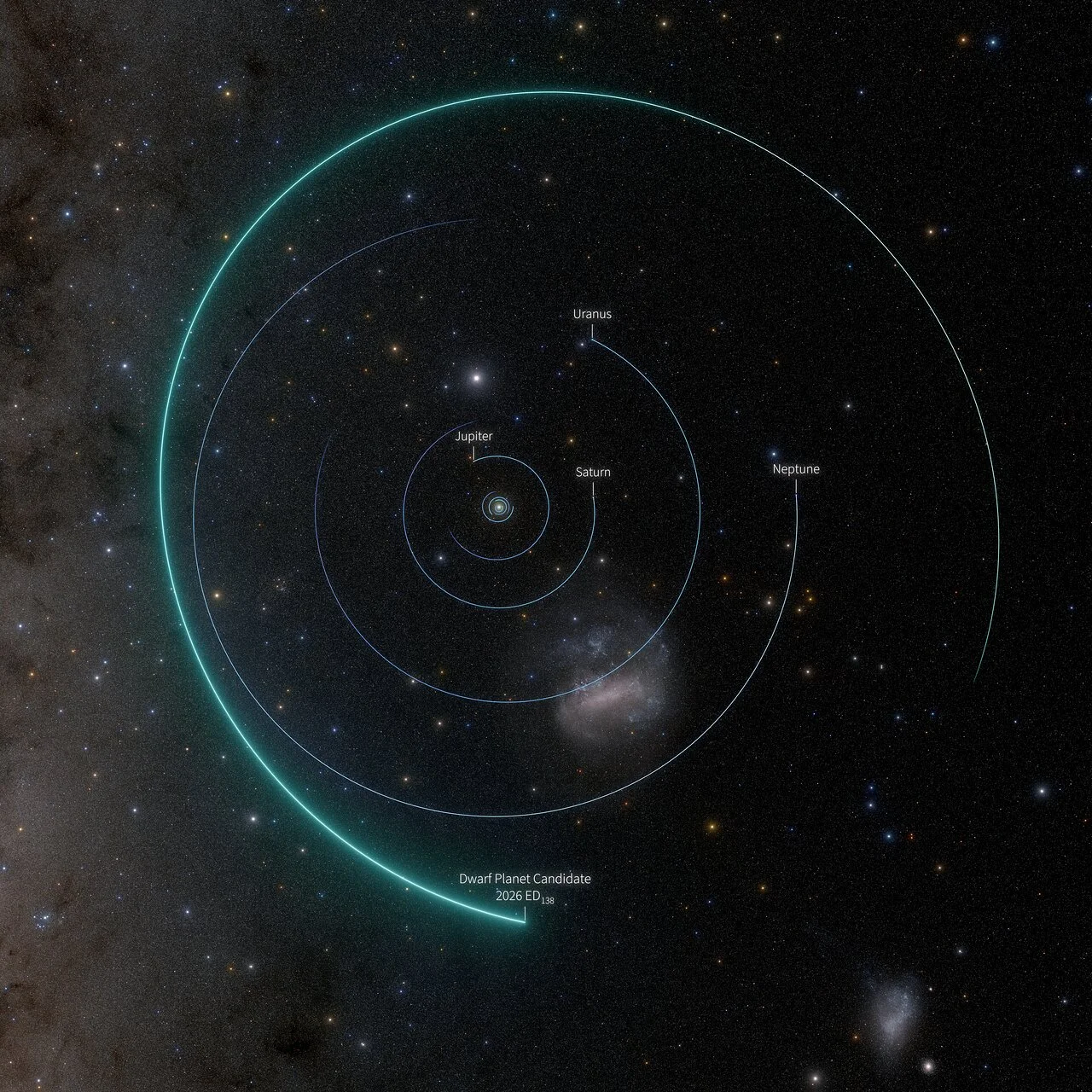
That unusual geometry may preserve evidence of gravitational disturbances during the Solar System's evolution.
But perhaps the most exciting implication is how many objects like it could still be waiting to be discovered.
Rubin Observatory is beginning a decade-long survey that will repeatedly photograph large areas of the sky, allowing scientists to detect objects that previous searches overlooked.
Its combination of an enormous camera, sensitive instruments and automated detection software makes it particularly powerful in densely populated star fields.
What happens next?
Astronomers will now attempt to determine ED138's actual size, surface reflectivity, composition and rotational properties.
Infrared observations may help constrain its diameter by measuring the weak thermal radiation it emits.
Future measurements will also refine its orbit and clarify whether it should be formally recognized as a dwarf planet.
For now, ED138 remains a distant point of light rather than a world whose surface we can see in detail.
But its discovery is a reminder that even our own Solar System still contains unexplored territory.
Some of the next worlds we discover may already be present in photographs taken years ago, waiting for someone to recognize them.