
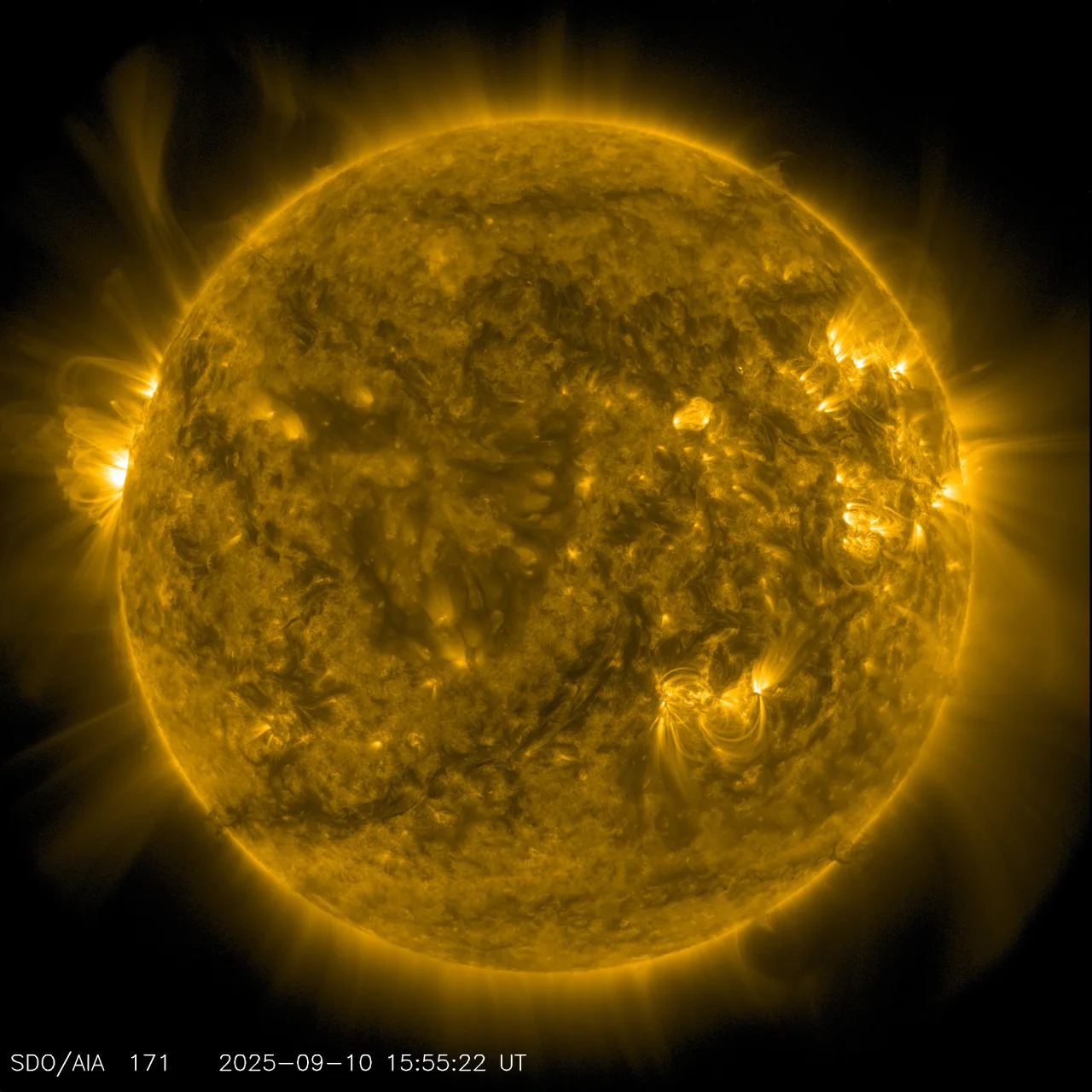
Look at the Sun, and it seems obvious what you're seeing: an enormous ball of fire burning in space.
But there's a problem with that explanation.
The Sun isn't on fire. Not in the way fire exists on Earth.
There are no giant flames consuming fuel in a chemical reaction. The Sun doesn't need a supply of oxygen to keep shining.
Instead, it is powered by something happening 150 million kilometers away from us, deep inside a star where temperatures reach 15 million degrees Celsius.
And understanding that process changes the way we see the most familiar object in our sky.
Why ordinary fire cannot explain the Sun
A candle flame, a burning log and a wildfire all release energy through chemical reactions.
In the familiar process of combustion, fuel reacts with oxygen, producing heat and often visible light.
The Sun works differently.
Although it contains small amounts of oxygen and other heavier elements, its energy does not come from burning them. The Sun consists overwhelmingly of hydrogen and helium, held together by its own immense gravity.
And there's another problem with the ordinary-fire explanation.
The Sun has been shining for approximately 4.6 billion years.
A star powered only by chemical combustion could never sustain its enormous energy output for anything close to that long.
Something far more powerful must be happening.
The nuclear furnace inside our star
At the center of the Sun, gravity compresses matter to extraordinary densities.
Temperatures reach approximately 15 million degrees Celsius, and the pressure is immense.
Under these conditions, hydrogen nuclei can undergo nuclear fusion.
Through a sequence of nuclear reactions known as the proton-proton chain, hydrogen is ultimately converted into helium.
The resulting helium has slightly less mass than the hydrogen that went into producing it.
That missing mass hasn't disappeared.
It has been converted into energy, following Einstein's famous relationship:
E = mc²
The amount is astonishing.
Every second, the Sun processes roughly 600 million tonnes of hydrogen, converting approximately 4 million tonnes of mass into energy.
This energy powers the sunlight that warms Earth, drives our climate and makes most life on our planet possible.
Unlike a chemical fire, nuclear fusion changes the nuclei of atoms themselves.
That is why a star can shine for billions of years.
If it isn't fire, what are those enormous flames?
Images from NASA's Solar Dynamics Observatory often show what look like giant flames, glowing loops and enormous eruptions rising above the Sun.
These structures can resemble fire on an unimaginable scale.
But they aren't flames.
Much of the Sun consists of plasma, a state of matter in which electrons are separated from atomic nuclei.
Because plasma contains electrically charged particles, its behavior is strongly influenced by magnetic fields.
Those magnetic fields can twist, stretch and channel solar material into spectacular structures.
Some become enormous arches called coronal loops. Others form prominences that extend high above the visible solar surface.
Solar flares release stored magnetic energy, rapidly heating plasma and accelerating particles.
These events can be violent and extremely energetic, but they are not chemical combustion.
There is another important detail about the spectacular solar images we see.
Many are recorded in ultraviolet or extreme-ultraviolet wavelengths invisible to human eyes. Scientists assign visible colors to those observations so that different structures and temperatures can be studied.
A bright orange or red solar image does not necessarily represent what the Sun would look like to a person viewing it in ordinary visible light.
The sunlight reaching Earth began a very long journey
Fusion happens deep inside the Sun, but the light we see escapes from its outer layers.
Between the core and the visible surface lies a vast region where energy moves through repeated interactions with matter.
Radiation is continually absorbed and re-emitted, changing direction again and again.
According to NASA, energy can take approximately 170,000 years to travel through the Sun's radiative zone.
The energy then moves through the convection zone, where hot plasma rises and cooler plasma sinks.
Eventually, it reaches the photosphere, the layer we recognize as the Sun's visible surface.
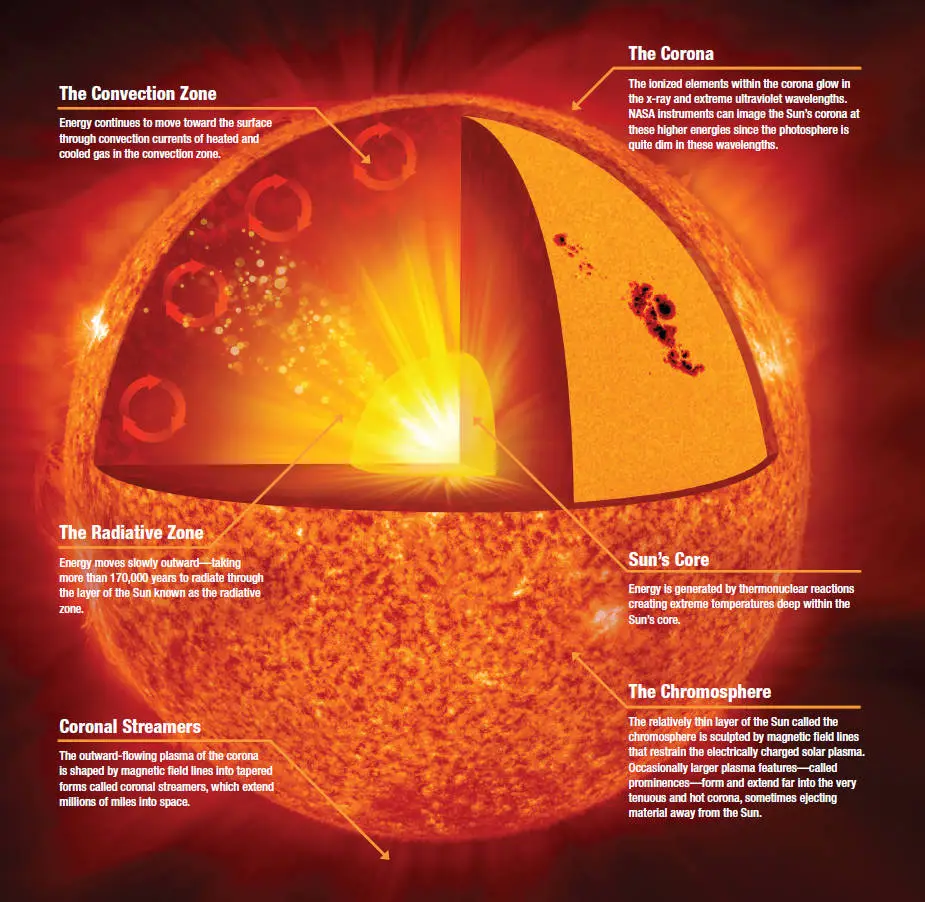
The photosphere is approximately 5,500 degrees Celsius, much cooler than the core but still extraordinarily hot.
From there, sunlight can finally travel freely through space.
And the final part of its journey is surprisingly short.
It takes only about eight minutes and twenty seconds for sunlight to travel from the Sun to Earth.
The energy that spent an immense amount of time moving through the Sun crosses the space between our star and our planet in just minutes.
Will the Sun eventually stop shining?
Yes, but not anytime soon.
The Sun is a middle-aged star, and scientists estimate that it has approximately five billion years of hydrogen-fusion activity remaining in its core.
As that supply of hydrogen becomes depleted, the Sun will eventually change dramatically.
Its core will contract and heat up, while its outer layers expand. It will become a red giant.
Much later, after shedding its outer layers, the remaining core will become a white dwarf.
Our Sun's future is determined not by a fire running out of oxygen, but by the changing balance between gravity, nuclear reactions and internal pressure.
A star, not a fire
From Earth, the Sun can seem almost ordinary.
It rises every morning, crosses the sky and disappears beyond the horizon.
But the familiar light we take for granted comes from a gigantic sphere of plasma, held together by gravity and powered by nuclear reactions at its center.
There is no enormous chemical fire burning in space.
There is a star transforming matter into energy, illuminating an entire planetary system.
And that is far more extraordinary than fire.