
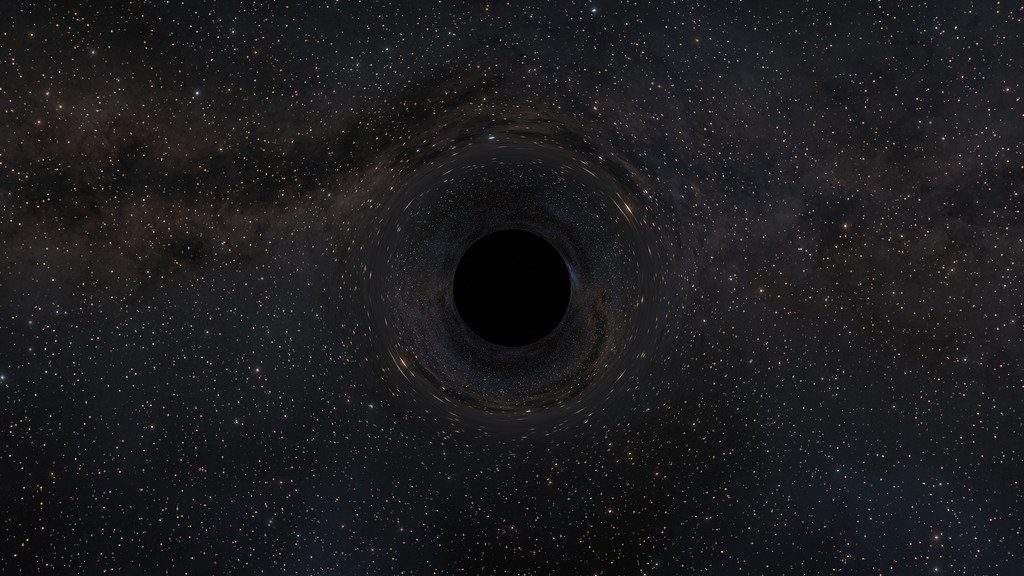
Imagine falling toward a black hole.
You might expect a violent collision, an enormous shock or some unmistakable moment when you cross into the unknown.
But according to Einstein's theory of general relativity, something far stranger could happen.
You could cross the event horizon of a supermassive black hole without feeling anything particularly unusual at that exact moment.
No solid surface. No sudden impact. No invisible wall.
And yet, the instant you cross that boundary, your future changes forever.
The invisible boundary of no return
A black hole is a region of spacetime where gravity has become so extreme that nothing inside a particular boundary can escape to the outside universe.
That boundary is called the event horizon.
It is often described as the point of no return, but it isn't a physical surface like the ground beneath your feet.
You wouldn't crash into it.
There is no material barrier separating the outside from the inside.
Instead, the event horizon marks a fundamental change in which paths through spacetime remain possible.
Outside a black hole, light and matter can still follow trajectories that lead away from it.
Inside the event horizon, even a beam of light directed outward cannot escape to distant space.
Every possible future-directed path leads deeper into the black hole.
And that's what makes crossing the horizon irreversible.
Why a supermassive black hole is different
Not all black holes would treat a falling astronaut in the same way.
Consider a relatively small black hole with a mass several times that of our Sun.
As you approached it, the gravitational pull on your feet could become dramatically stronger than the pull on your head.
This difference is called a tidal force.
It would stretch your body lengthwise while compressing it in other directions, an effect known as spaghettification.
Near a small black hole, these forces could tear you apart before you ever reached the event horizon.
But a supermassive black hole is different.
The black holes found at the centers of large galaxies can contain millions or billions of times the mass of the Sun.
Their event horizons are vastly larger.
For a sufficiently massive black hole, the difference in gravitational pull across your body at the horizon can be relatively small.
If you were falling freely, and if you somehow avoided the dangerous radiation and hot gas that may surround the black hole, you could potentially remain intact while crossing its event horizon.
The boundary that seals your fate might not announce itself at all.
What would you actually see?
Although crossing the horizon might not produce a sudden physical sensation, the journey toward it would be visually extraordinary.
A black hole dramatically bends the paths of passing light.
This phenomenon, called gravitational lensing, can distort the apparent positions and shapes of background stars.
Light from objects behind the black hole can bend around it, forming strange arcs and multiple images.
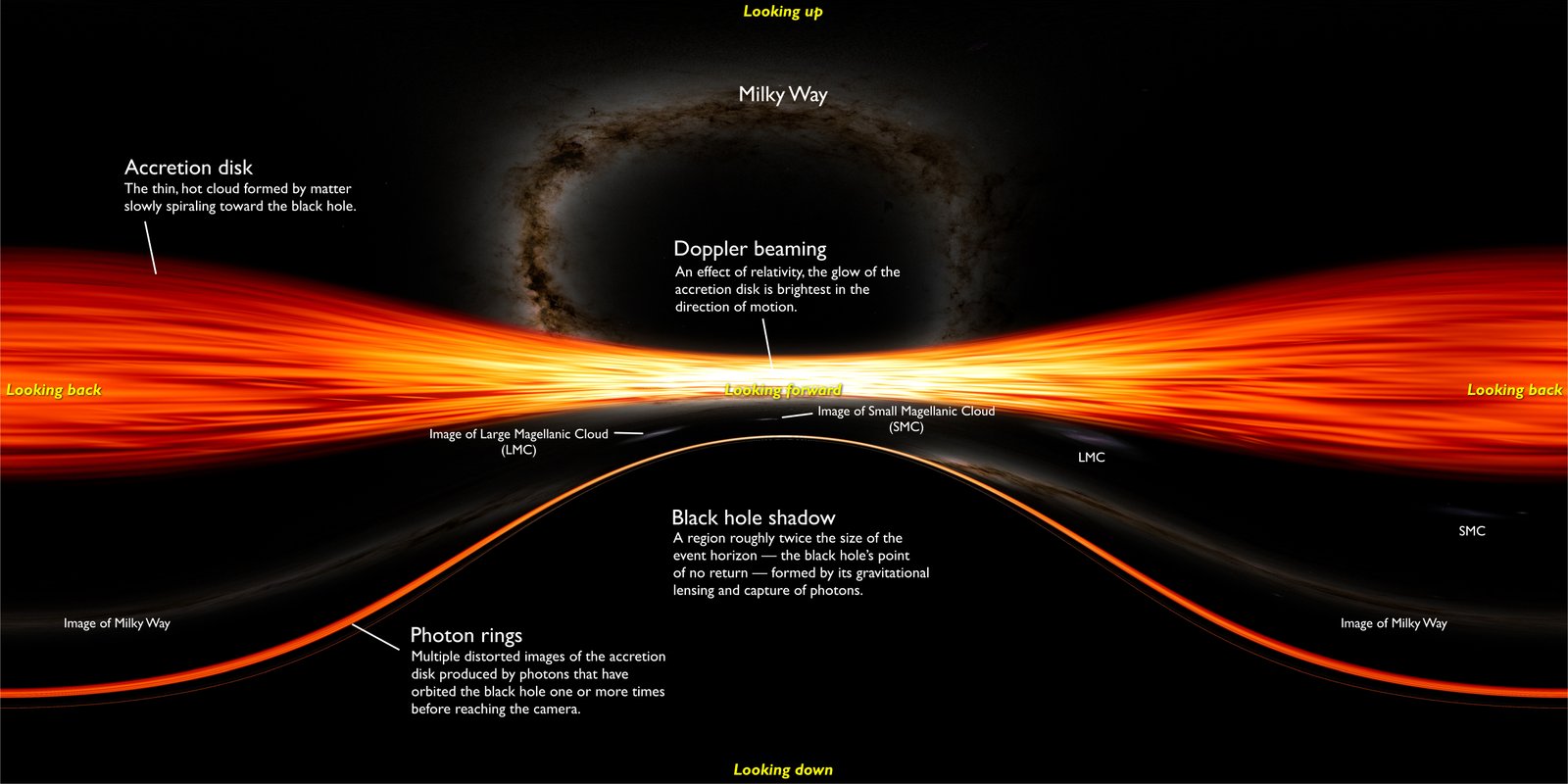
If the black hole is surrounded by a glowing disk of hot gas, known as an accretion disk, that disk may appear warped into shapes that seem almost impossible.
Parts of the disk located behind the black hole can become visible above and below its dark silhouette.
Light can even travel around the black hole before escaping toward an observer.
But there is an important distinction.
The dramatic glowing rings commonly shown in black hole visualizations are not the event horizon itself.
They come from surrounding matter and light distorted by gravity.
An isolated black hole without a bright accretion disk would look very different.
And what an astronaut sees would depend on the black hole's mass, rotation, surrounding environment and the astronaut's trajectory.
NASA simulated the journey
In May 2024, NASA released a remarkable supercomputer visualization showing what a journey toward a supermassive black hole might look like.
The simulation was created by astrophysicists Jeremy Schnittman and Brian Powell at NASA's Goddard Space Flight Center.
Their virtual destination was a nonrotating black hole containing approximately 4.3 million times the mass of the Sun, similar in mass to Sagittarius A*, the black hole at the center of our galaxy.
Its event horizon measured approximately 25 million kilometers across.
The simulation followed a camera as it approached the black hole, passed through increasingly distorted regions of spacetime and eventually crossed the event horizon.
In this specific simulated trajectory, the camera was destroyed by tidal forces only 12.8 seconds after crossing.
That number is not a universal countdown for falling into black holes.
The time depends on the black hole and the trajectory.
But the simulation demonstrates something extraordinary: crossing the horizon does not necessarily mean immediate destruction.
What would someone watching from far away see?
Now imagine that another spacecraft remains at a safe distance, observing your fall.
Its view of events would differ dramatically from yours.
As you approached the event horizon, light carrying information about your movements would become increasingly delayed and gravitationally redshifted.
Your image would appear to slow down, becoming progressively dimmer and harder to detect.
In the idealized description of a stationary black hole, a distant observer would never receive a light signal showing you actually crossing the horizon.
But from your own perspective, the experience would be very different.
Your clock would continue ticking normally.
You would cross the event horizon after a finite amount of your own time.
You would not experience your personal time stopping.
This apparent contradiction is one of the consequences of general relativity: different observers can measure time and describe events differently in strongly curved spacetime.
What happens after the event horizon?
This is where the story becomes both more predictable and more mysterious.
According to classical general relativity, once you cross the event horizon, there is no future trajectory that returns you to the outside universe.
For an idealized nonrotating black hole, your journey inward ultimately leads toward what the mathematical theory describes as a singularity.
But a singularity is also a warning that our current physical description may be incomplete.
General relativity predicts extreme spacetime curvature under these conditions, while quantum physics suggests that a more complete theory of gravity may be necessary.
Scientists do not yet know exactly how matter and spacetime behave under the most extreme conditions inside a black hole.
The event horizon itself is a well-established prediction of general relativity.
What ultimately happens deep inside remains an open problem in fundamental physics.
And no information sent outward from within the horizon can reach a distant observer to tell us what happened.
The strangest journey in the universe
Black holes are often portrayed as cosmic monsters that instantly destroy anything approaching them.
The reality is more subtle.
A small black hole could tear you apart before you crossed its horizon.
A sufficiently massive one might let you pass that invisible boundary without an immediate physical warning, assuming you survived the surrounding environment.
But the absence of a dramatic moment would not make the event any less significant.
You would have crossed the boundary separating the universe you could still return to from a region where escape is impossible.
You might not notice the exact moment you entered a black hole.
But the universe outside would never see you return.