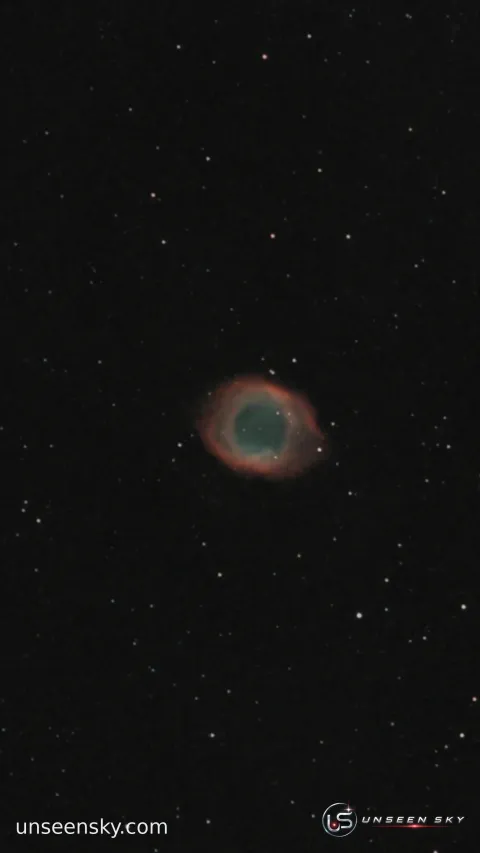

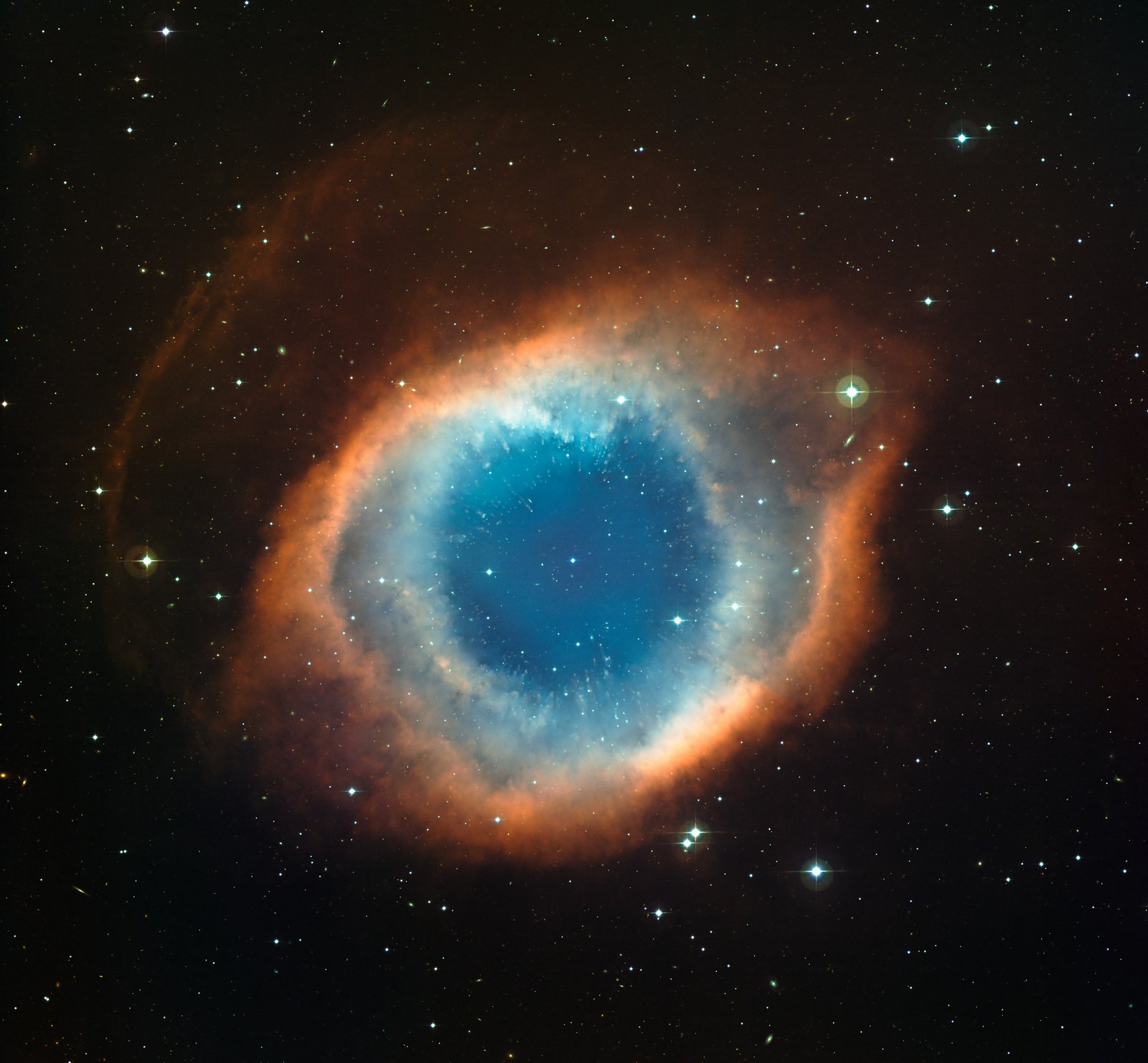
At first glance, the Helix Nebula looks like an enormous eye opening in the darkness. Its luminous ring, soft blue-green interior and faint outer structures make it one of the most recognizable deep-sky objects.
Yet what we are seeing is not an eye, a portal or a distant galaxy. It is the aftermath of a star leaving its ordinary life behind.
NGC 7293, the Helix Nebula, is a nearby planetary nebula in the constellation Aquarius, at a distance often quoted as roughly 700 light-years. The name is a historical trap.
Planetary nebulae have nothing to do with planets. Early observers saw rounded, planet-like disks through small telescopes and the label remained.
A star does not die all at once
A star spends much of its life balancing gravity against the pressure generated by nuclear fusion. When conditions in the core change, that balance must adjust. During later evolutionary stages, the outer layers can swell outward into a red giant envelope.
Eventually, a Sun-like star can expel much of its surrounding gas. What remains is a hot, compact core destined to cool as a white dwarf. Its ultraviolet radiation ionizes the expanding gas around it, making the nebula shine.
The Helix is therefore not a cloud waiting to form a new star. It is largely material that an older star has returned to space.
The distinction matters because images of gas and dust can look superficially similar even when they represent opposite chapters of stellar evolution.
Why the ring looks like a ring
Astronomical objects are three-dimensional, but photographs compress them onto a two-dimensional sky. A glowing shell or complex set of shells may appear brightest where our line of sight passes through more emitting material.
This is part of the explanation for the Helix's circular, eye-like appearance. The structure is not a neatly painted flat disk with a hole in its middle.
It is a complicated distribution of expanding gas, with layers, knots and filaments that overlap in projection.
Different wavelengths bring out different features. The ESO Wide Field Imager view combines optical filters sensitive to the visible glow of the gas.
Blue-green emission near the centre is associated with oxygen excited by radiation from the extremely hot central star, while redder structures farther out trace other emitting species, including hydrogen and nitrogen.
The comet-shaped knots
One of the most remarkable details in the Helix is its population of dense knots. They can resemble tiny comets, each with a bright head and a tail-like extension. The resemblance is visual; these are not ordinary Solar System comets orbiting the Sun.
Their bright tips and darker trailing structures form as radiation and flowing gas interact with denser pockets of material. The hot central source illuminates and changes the surrounding gas, while the knots resist some of the erosion.
In 2026, new James Webb imaging provided a close look at a portion of the Helix, highlighting these intricate structures. Near-infrared observations can reveal details and cooler material not emphasized in conventional visible-light images.
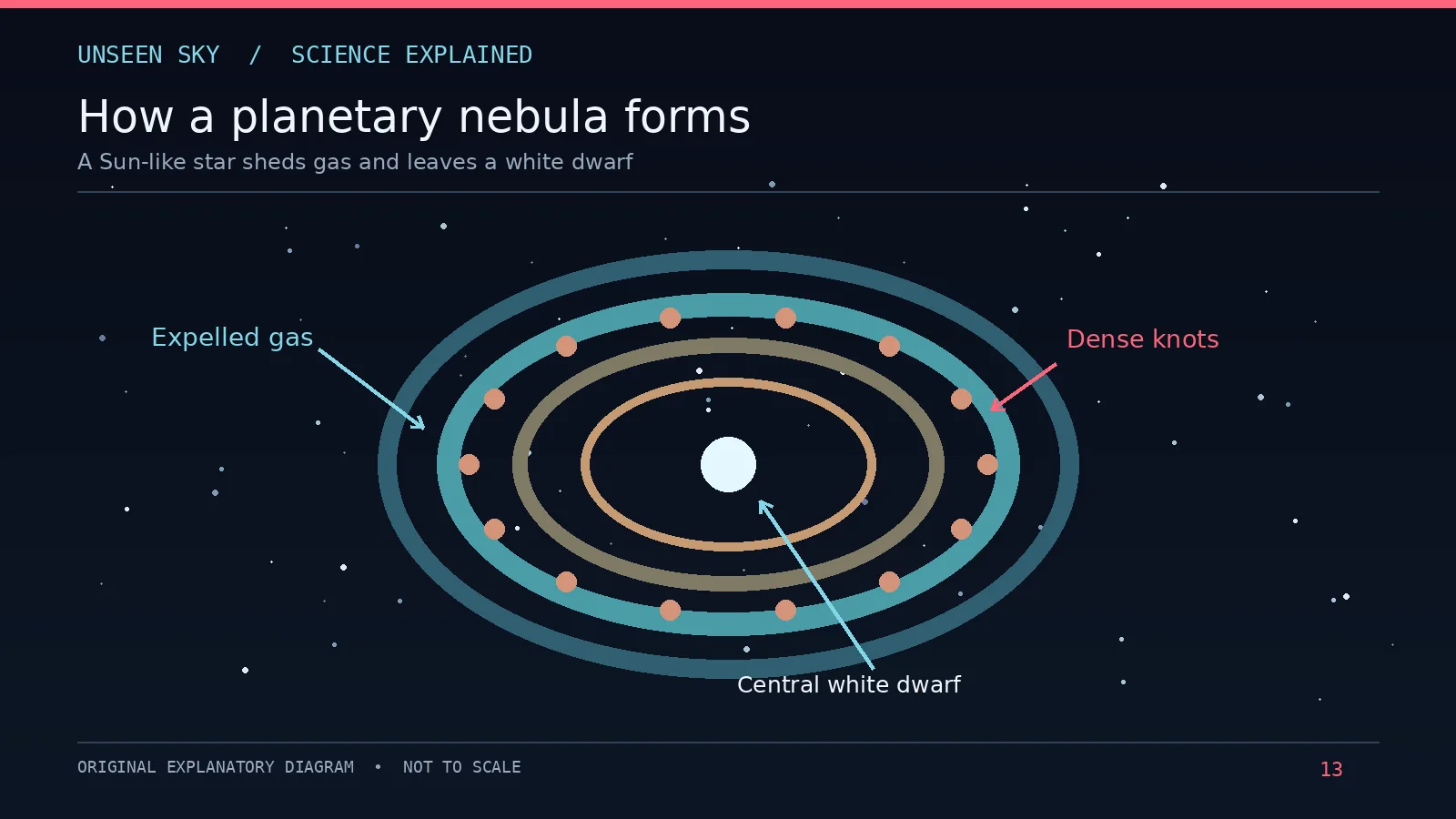
Unseen Sky original explanatory diagram. Schematic, not to scale.
What a small telescope sees
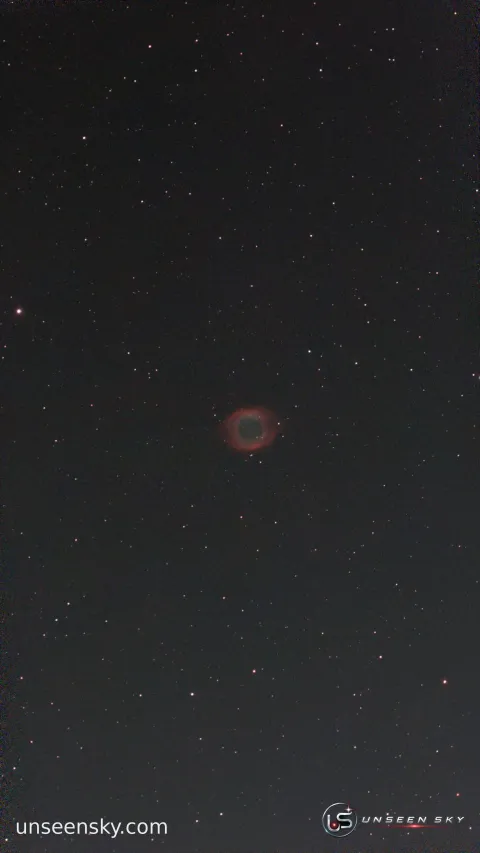
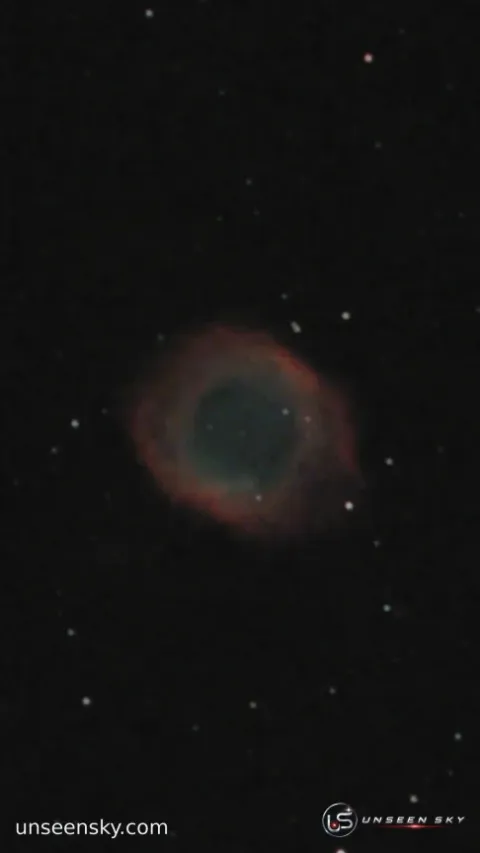
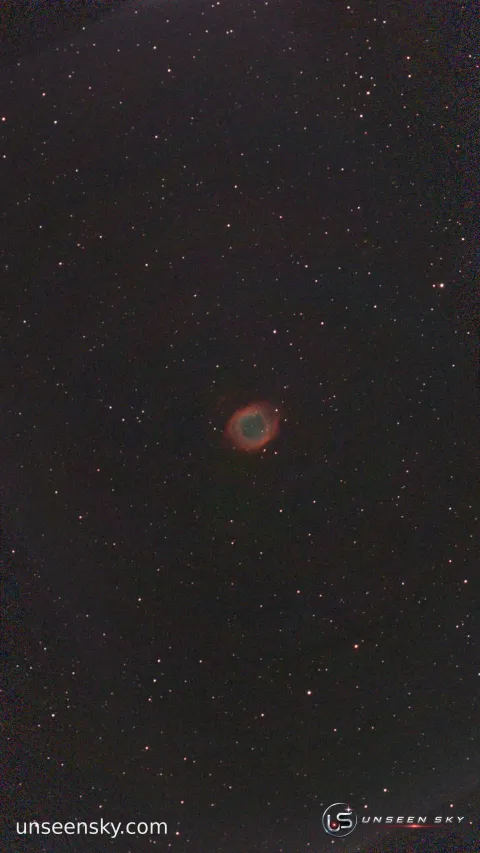
A compact telescope can record the Helix, but the result depends strongly on observing conditions, integration time and the way the data are processed. The nebula spreads its light across a considerable area of sky.
That makes its surface brightness a challenge even though the entire object is relatively well known.
A single short exposure may show little more than a faint patch. Repeated exposures can be aligned and combined to improve the visibility of faint structure.
The trick is not to invent signal but to make a weak real signal easier to distinguish from noise.
But there is scientific value in showing what a real instrument can capture. The gap between a raw frame and a finished stack tells the story of how observations are made.
It is an opportunity to explain signal, uncertainty and image processing rather than hide them.
Could this be the Sun's future?
Yes, with important qualifications. A star like our Sun is expected to evolve through a red-giant phase and eventually become a white dwarf. The Helix demonstrates a class of evolutionary processes relevant to that future.
Earth's future is a separate question. Long before the Sun reaches its final white-dwarf stage, increased luminosity and later red-giant expansion will profoundly change conditions throughout the inner Solar System.
It would be misleading to interpret a photograph of the Helix as a precise prediction of the future appearance of our planets.
The Galaxy's recycling system
Stars create and redistribute elements. Material expelled in late evolutionary stages can mix into interstellar clouds, where it may later become part of other stars or planetary systems.
A planetary nebula makes this movement of matter visible. Its glowing gases are a record of a changing stellar interior and an expanding envelope.
Their spectra reveal composition and physical conditions. Their shape preserves clues about the way the material was expelled and illuminated.
A familiar shape with an unfamiliar scale
When we see the Helix on a screen, it is easy to forget the distance. The light left the object centuries ago.
The ring is not an instant in a familiar human environment, but a projected view of enormous clouds evolving over thousands of years.
For observers, that makes every image feel a little more meaningful. We are not witnessing a sudden explosion in real time. We are observing the visible aftermath of a long transition whose light has travelled a very long way to reach us.
The Helix Nebula is a glimpse of how stars return their material to the cosmos. And, in a broad evolutionary sense, it offers a distant preview of the path our own Sun will eventually follow.