
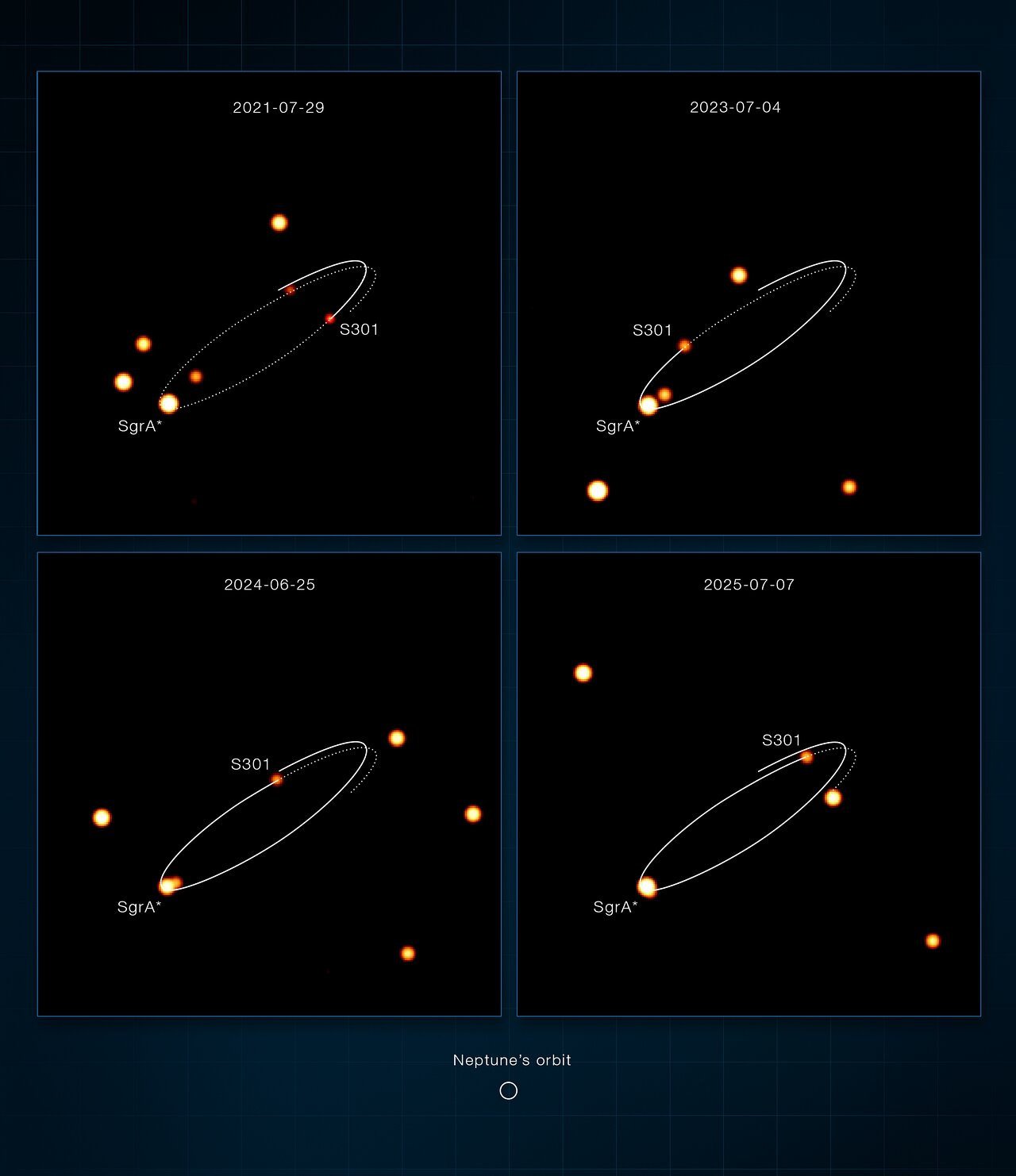
Imagine watching a star fly around a black hole so quickly that, at its fastest, it covers about 25,000 kilometres every second. That is more than eight percent of the speed of light.
Yet the star remains in orbit, tracing a path through one of the most extreme gravitational environments in our Galaxy.
In August 2026, astronomers using the European Southern Observatory's Very Large Telescope Interferometer announced a remarkable new object in the crowded centre of the Milky Way. The star, designated S301, is the fastest known star in our Galaxy in the team's measurements, and its orbit brings it exceptionally close to Sagittarius A\*, the supermassive black hole at the Galactic Centre.
The Galactic Centre is not a quiet place
The Milky Way's central black hole contains about four million times the mass of our Sun. We cannot see the black hole itself as a luminous sphere.
Instead, astronomers infer its presence from the motion of nearby stars, emissions from surrounding material and observations of the compact region around the event horizon.
The stars near Sagittarius A\* form a crowded and often difficult population to study. They are partly hidden by dust between Earth and the Galactic Centre. Infrared observations are essential because some infrared wavelengths penetrate that dust more effectively than visible light.
For decades, astronomers have tracked so-called S-stars orbiting the black hole. Some follow extremely elongated paths, rushing through their closest approaches and spending more time farther away.
Measuring those orbits requires tremendous angular precision. The Galactic Centre is roughly 26,000 light-years away, so two objects that appear nearly superimposed in an ordinary image may still be separated by immense distances in space.
How do you find a star that close?
ESO's VLTI combines light from multiple telescopes to achieve extremely fine angular resolution. Its instruments have allowed researchers to resolve and track stars moving in a region where standard imaging struggles to separate the sources.
That is particularly powerful near Sagittarius A\*. The central region contains stars that cross close together on the sky. Identifying which point of light belongs to which star, night after night and year after year, is a demanding process.
What does 25,000 kilometres per second mean?
The number is almost too large to imagine. Light travels about 300,000 kilometres in one second through vacuum. S301's reported peak speed is a substantial fraction of that value, fast enough that relativistic effects become relevant to any precise description of its motion.
But the star is not firing across the galaxy in a straight line at that speed. It is accelerating along an orbit around a central mass. Near its closest approach, it moves fastest; farther out, it moves more slowly.
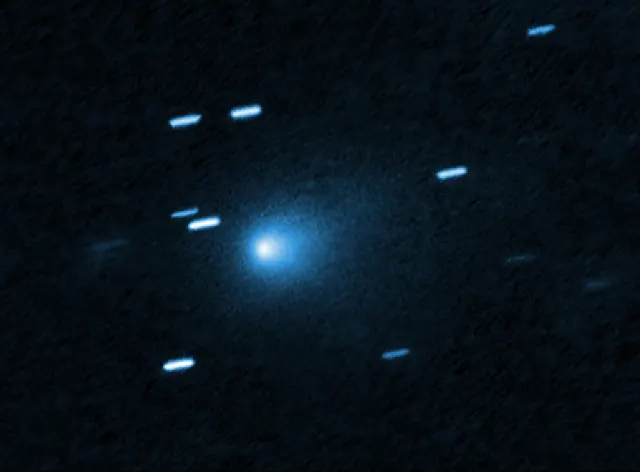
That behaviour is already familiar in Newtonian orbital mechanics. A comet on a highly elongated orbit also speeds up near the Sun and slows down farther away.
The difference is the extraordinary strength of gravity near Sagittarius A\*. Under such conditions, the precise orbital path can reveal phenomena that Newton's equations approximate but do not fully capture.
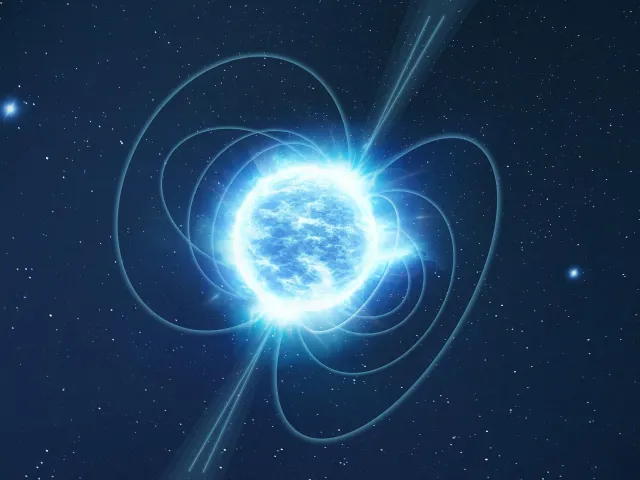
Einstein's general relativity describes gravity as the geometry of spacetime. Near a rotating black hole, the details of that geometry may subtly influence the motion of nearby objects.
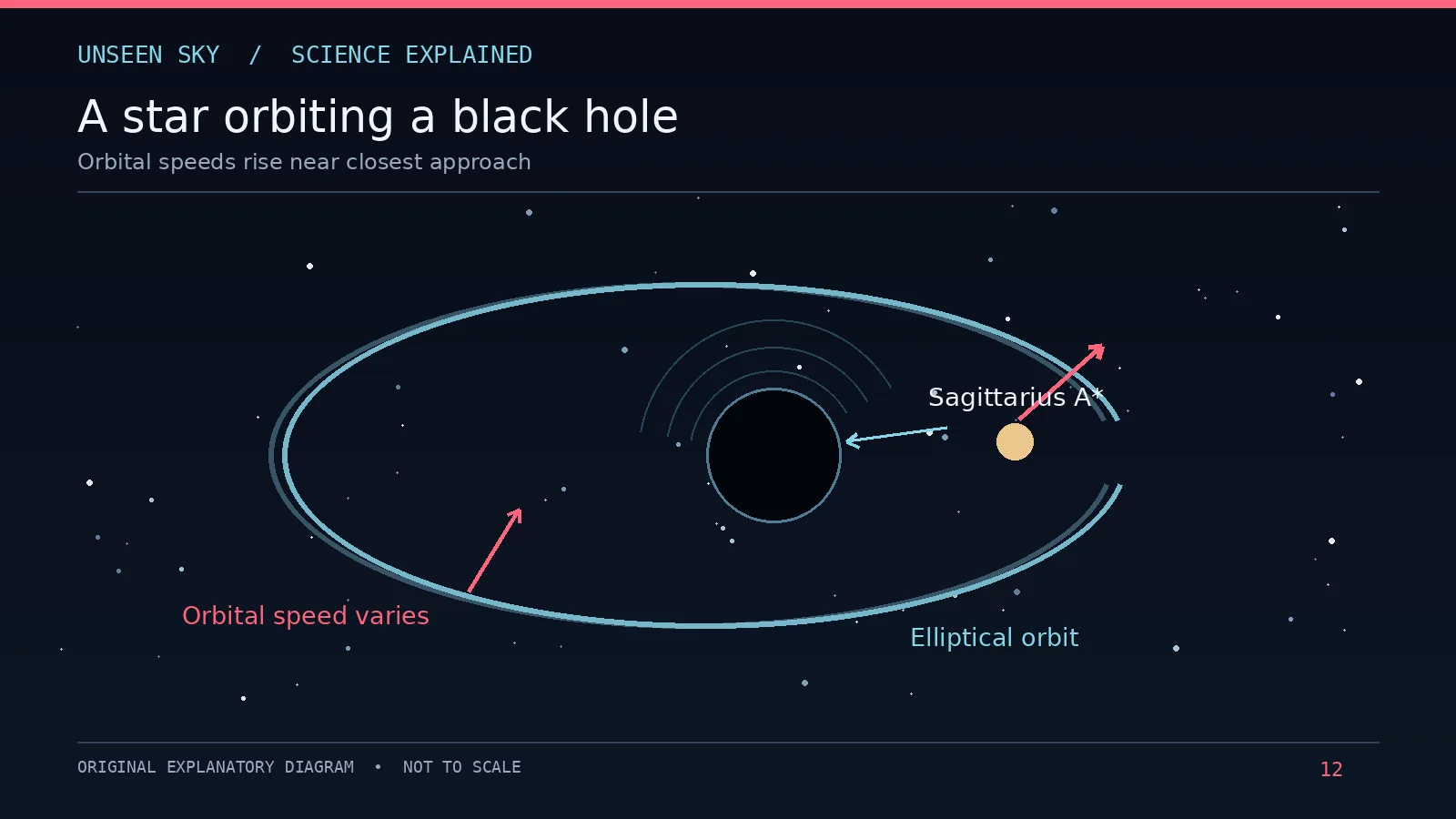
Unseen Sky original explanatory diagram. Schematic, not to scale.
The black hole's spin enters the story
Black holes can rotate. In general relativity, a rotating mass affects the surrounding spacetime in ways that can alter orbital motion. One effect, often discussed under the name frame dragging, is particularly interesting for objects that approach a rapidly spinning compact body.
The ESO researchers describe S301 as an especially promising probe of the effects of Sagittarius A\*'s rotation. This should not be read as a claim that astronomers have already measured every spin parameter with absolute certainty from this one star.
What they have found is an orbit that could make such tests much more practical. By continuing to track S301 and other stars, researchers can compare the observed path with predictions from general relativity under different assumptions about the black hole.
Any real analysis must consider more than one influence. Nearby stars, possible extended mass distributions, measurement uncertainties and relativistic corrections can all affect how an orbit appears.
Why stars are useful test particles
A black hole is difficult to examine directly because the event horizon does not emit light that can escape. Yet gravity acts on ordinary matter outside it. Stars moving nearby become natural probes of the gravitational field.
If scientists can measure a star's position and speed over time, they can constrain the mass and geometry of the region governing its orbit. Different stars, following paths of different sizes and orientations, sample different parts of the gravitational environment.
That makes a collection of orbits more valuable than any single record holder. One star may have excellent positional measurements. Another may approach closer. A third may occupy a trajectory that is especially sensitive to a particular theoretical effect.
The approach has already produced famous results. Precise monitoring of other Galactic Centre stars provided some of the strongest evidence for the existence of a compact supermassive object and has revealed relativistic effects in stellar motion.
An extraordinary orbit is still a stellar life
Orbiting close to a black hole does not automatically mean crossing the event horizon. Stable or long-lived orbits are possible outside the region from which light cannot escape, though the strongest gravitational environments are not forgiving.
What the next observations could reveal
Future data can refine S301's orbit, test the stability of the inferred path and help separate the influence of the black hole from surrounding matter. Combined with measurements of other S-stars, those observations may help constrain Sagittarius A\*'s spin and the behaviour of spacetime around it.
That would be more significant than the speed record itself. General relativity has performed extraordinarily well under many conditions. Extreme environments offer opportunities to test whether it continues to describe nature when gravity is stronger than anything we can reproduce on Earth.
S301 is a reminder that the fastest thing in the story is not always the most important. The real discovery is how a star's orbit can reveal the shape of spacetime near a black hole.