
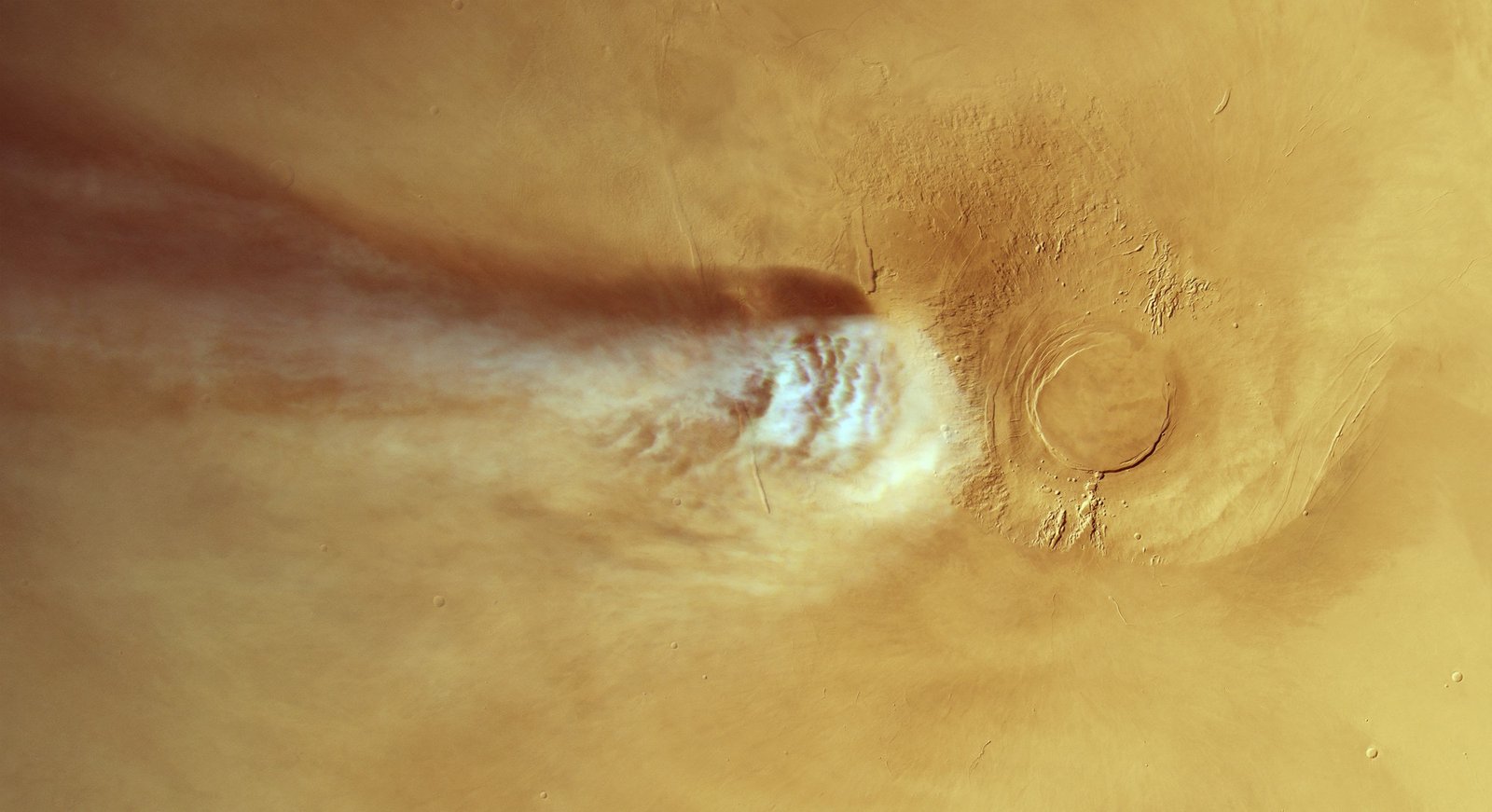
Every morning for part of the Martian year, a white ribbon appears beside an enormous volcano. It stretches across the rusty landscape, sometimes reaching an astonishing 1,800 kilometres in length, and then fades away. The next morning it can return.
If this happened over a mountain on Earth, we might think of an ordinary cloud forming in rising air. On Mars, the conditions are more extreme, and the physics may be stranger than researchers once thought.
New modelling reported by the European Space Agency in October 2026 offers a fresh explanation for the Arsia Mons Elongated Cloud, or AMEC. The phenomenon is made of water ice, not smoke from an erupting volcano.
It appears to depend on a delicate balance of atmospheric flow, temperature, water vapour and perhaps an unusual way for ice crystals to begin forming.
A volcano taller than most of our imagination
Arsia Mons belongs to the vast Tharsis volcanic region of Mars. It rises roughly 20 kilometres above its surroundings, dwarfing the scale of most terrestrial mountains.
A landscape that dramatic inevitably influences the air flowing around it. When Martian winds encounter the terrain, the atmosphere can be pushed upward, cooled and disturbed. Under suitable conditions, water vapour can condense or freeze into clouds.
The long white streamer appears on the downwind side of Arsia Mons, not as an eruptive plume from its summit. That distinction matters because a casual glance at an image could suggest volcanic activity where none is being claimed.
A remarkable daily routine
Mars Express first brought the recurring Arsia Mons cloud to wide attention in 2018. Since then, scientists have monitored its seasonal appearances and compared observations across years.
The cloud tends to develop during southern spring and summer, when particular atmospheric conditions recur. It begins near the mountain, grows into a long streamer and evaporates or dissipates as the day progresses.
Unlike a weather system that simply floats across the map, this feature appears connected to a consistent location and a repeating set of conditions. The timing is part of what makes it useful to researchers.
An image taken on June 24, 2024, by Mars Express's High Resolution Stereo Camera shows about 980 kilometres of the cloud, according to ESA. Other observations show that the phenomenon can become much longer. The maximum figure is not the length of every daily appearance.
How does water freeze in almost empty air?
Mars has an atmosphere far thinner than Earth's, composed mostly of carbon dioxide. Water is present in much smaller quantities, and the conditions under which it forms clouds are very different from those in our weather systems.
Cloud formation depends on tiny particles or other mechanisms that allow molecules to assemble into droplets or ice crystals. On Earth, aerosols such as dust and sea salt often act as nuclei.
These tiny surfaces can make it easier for condensed material to form.
The new Mars modelling explores whether homogeneous nucleation—the formation of new ice particles without the usual assisting dust nuclei—may contribute to Arsia Mons's unusual cloud. That would be a demanding process under many conditions, which is why the hypothesis attracts attention.
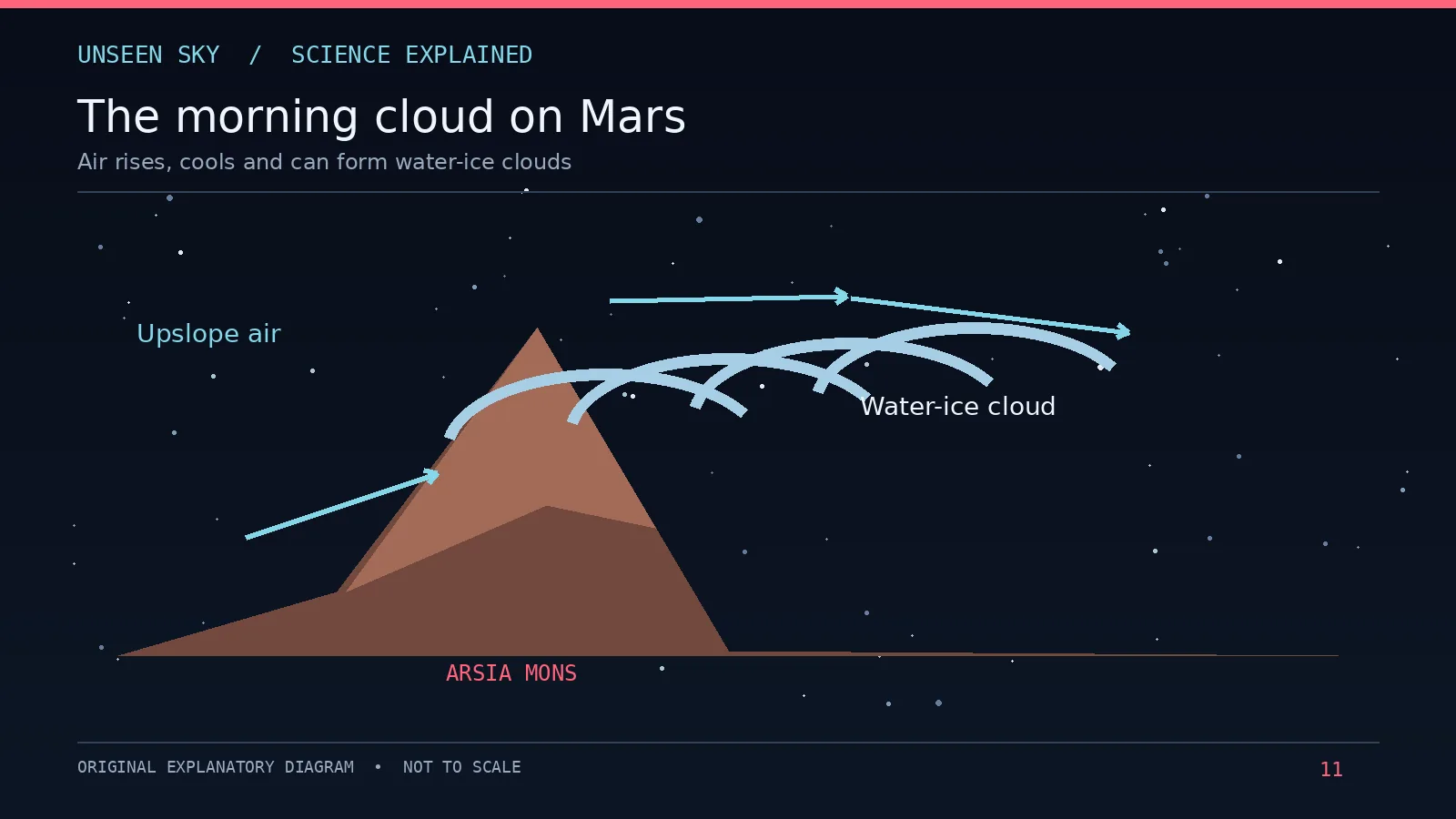
Unseen Sky original explanatory diagram. Schematic, not to scale.
Gravity waves are not gravitational waves
The atmosphere moving over a giant mountain can generate atmospheric gravity waves. The name can be confusing. These are not gravitational waves travelling through spacetime from colliding black holes.
Atmospheric gravity waves are oscillations in a fluid where buoyancy and gravity act as restoring forces. In Earth's atmosphere they can produce rippling clouds and other patterns.
On Mars, a mountain as large as Arsia Mons can create dramatic lifting and cooling under the right circumstances.
In the Martian case, the mountain shapes the airflow. The air's temperature and humidity determine whether clouds can grow. The microphysics determines how ice particles form. All of these processes have to fit together for a narrow, extended morning cloud to appear reliably.
What an orbiter sees—and what it cannot
Mars Express has the advantage of observing the planet from above and from changing viewing geometries. It can watch features too large to appreciate from the ground. But a satellite photograph still gives only a particular projection at a particular time.
To understand a cloud's entire daily life cycle, scientists need repeated views and supporting models. Some spacecraft images are separated by long intervals. Lighting, orbit and imaging geometry change. Dust storms and seasonal variations can complicate comparisons.
But models should be judged by their predictions. Can they reproduce the timing and shape of the event?
Do they explain why the cloud appears for months in some seasons and disappears in others? Can the same equations describe related clouds elsewhere on Mars?
Why the cloud matters beyond Mars
The Martian atmosphere is not a copy of Earth's, but the fundamental laws of fluid dynamics and thermodynamics apply to both. Learning how clouds form under exceptionally low pressure and cold temperatures helps us understand which processes are universal and which depend on local conditions.
A planet with a daily surprise
It forms in the shadow of a giant volcano, grows into the dawn sky and then vanishes. The process has repeated for years, long before humans learned to recognize it in orbital images.
The October 2026 modelling does not close the case completely. It offers a stronger physical explanation and a route for future tests. That is how planetary science progresses: repeat the observation, improve the model, compare the two, and keep the uncertainties visible.
Mars is often pictured as a still, rust-coloured desert. Arsia Mons's astonishing morning cloud reminds us that it is also a world with weather, rhythms and unanswered questions.