
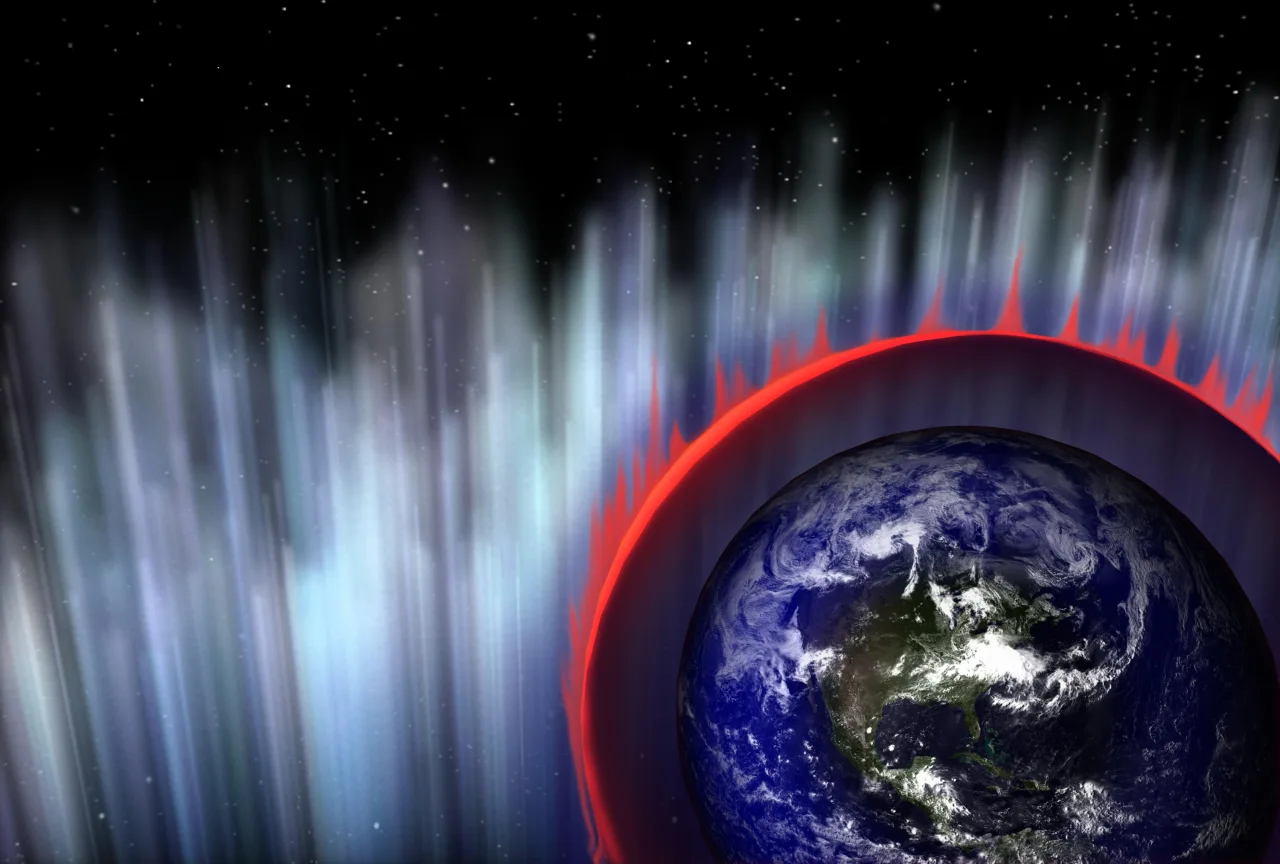
On December 27, 2004, an extraordinary flash of radiation swept through the Solar System and struck Earth's upper atmosphere.
It did not come from the Sun.
The source was a distant stellar remnant known as SGR 1806-20, located tens of thousands of light-years away, on the other side of the Milky Way.
For roughly two-tenths of a second, it released an almost unimaginable amount of energy. The initial flash was so intense that it overwhelmed instruments aboard several spacecraft.
And despite the enormous distance, the radiation produced a measurable disturbance in Earth's ionosphere.
The source was not an ordinary star.
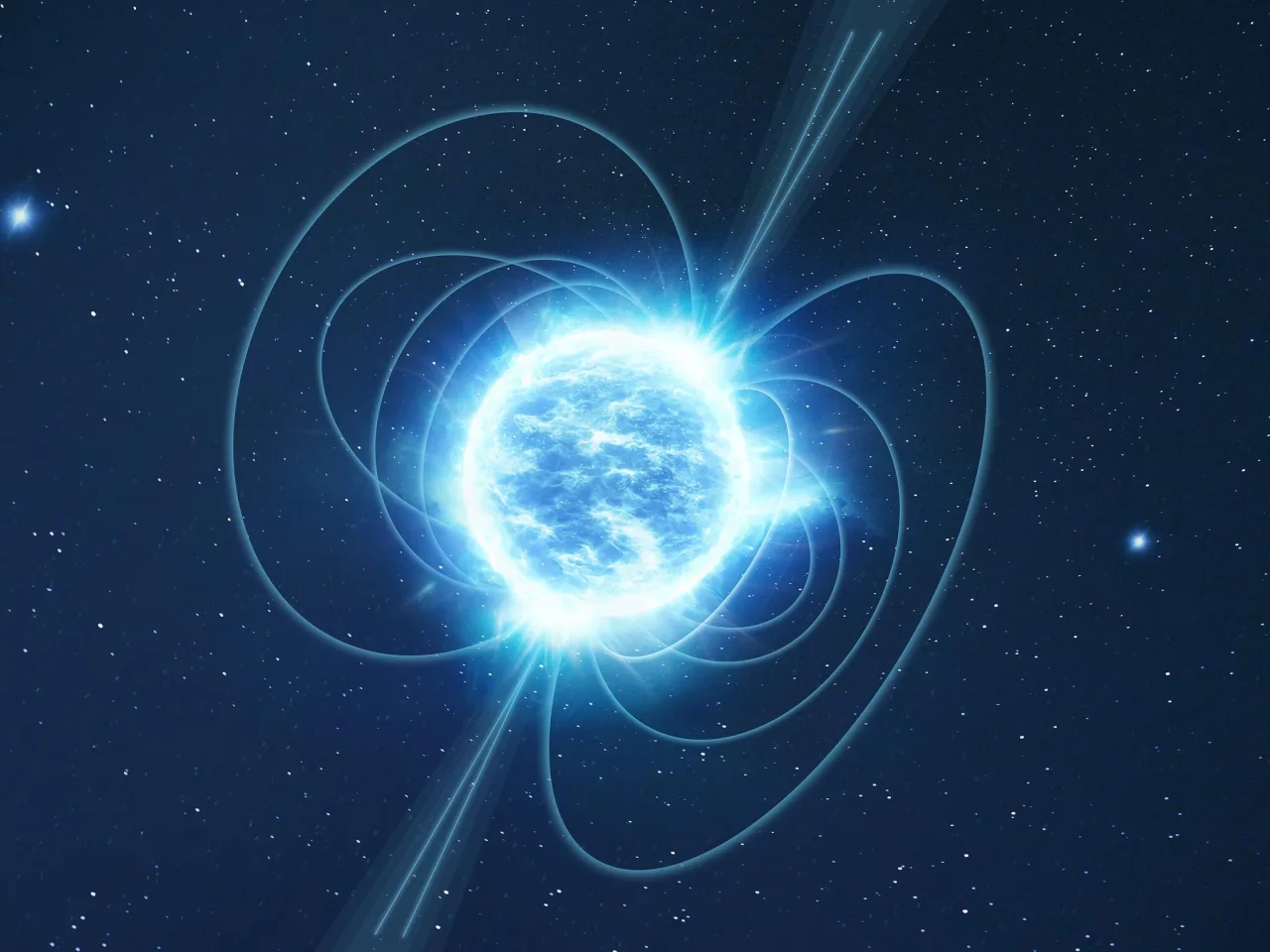
It was a magnetar, one of the most extreme objects known to exist.
The day a distant star reached Earth
The event began with a sudden burst of gamma rays, the most energetic form of electromagnetic radiation.
Spacecraft designed to monitor high-energy events detected an exceptionally intense flash. NASA's Swift and RHESSI observatories were among the missions that recorded evidence of the eruption.
The initial pulse lasted only about 0.2 seconds.
Yet according to research published in Nature in 2005, that brief flash released approximately as much energy as the Sun radiates over 250,000 years.
A much weaker, pulsating tail followed, lasting several minutes.
The source was identified as SGR 1806-20, a highly magnetized neutron star in our galaxy.
Its radiation had traveled for tens of thousands of years before reaching Earth.
But what made the event especially remarkable was not merely its brightness.
The burst was powerful enough to affect our planet.
What happened to Earth's atmosphere?
Earth is surrounded by an electrically charged region of the upper atmosphere called the ionosphere.
High-energy radiation from the Sun normally influences this region, altering the concentration of charged particles and affecting the propagation of certain radio signals.
On December 27, 2004, radiation from SGR 1806-20 caused a sudden change in the ionosphere's electrical properties.
Scientists detected the disturbance through changes in very-low-frequency radio signals.
The effects were measurable even though the magnetar was approximately 50,000 light-years away, according to widely cited distance estimates.
The event did not destroy Earth's atmosphere or produce a visible catastrophe at the surface.
There was no giant shock wave physically shaking the ground.
Instead, the incoming gamma rays interacted with the upper atmosphere, changing its ionization.
That distinction matters.
A star on the far side of our galaxy had influenced Earth's environment through radiation alone.
To understand how, we need to look at the extraordinary object responsible.
What exactly is a magnetar?
A magnetar is a special kind of neutron star, the compact remnant left behind when the core of a massive star collapses.
During a core-collapse supernova, the outer layers of the star may be expelled into space while its central region is compressed into an extraordinarily dense object.
The result can contain more mass than our Sun within a sphere roughly 20 kilometers across.
A neutron star is already one of the most extreme objects in the universe.
A magnetar takes that extremity even further.
Its defining feature is an immensely powerful magnetic field.
Typical magnetars can have surface magnetic fields reaching approximately 10¹⁴ to 10¹⁵ gauss.
For comparison, Earth's magnetic field is roughly half a gauss near the surface.
The difference is almost impossible to imagine.
These magnetic fields can dominate the behavior of charged particles surrounding the star, influence its crust and power intense bursts of X-rays and gamma rays.
Unlike an ordinary star, which shines primarily through nuclear fusion in its core, a magnetar's unusual high-energy activity is largely powered by magnetic energy.
But that energy cannot always remain stored peacefully.
When a star's crust gives way
A magnetar is not a giant ball of ordinary gas.
Beneath its outer layers lies extraordinarily dense matter under immense pressure.
Its outer crust is thought to form a rigid structure, while the interior contains matter in states that cannot be recreated easily in laboratories on Earth.
The star's magnetic field evolves over time.
As the field changes, it can place enormous stresses on the crust and surrounding magnetosphere.
Eventually, some of that stress may be released suddenly.
One proposed mechanism is a starquake, a violent rearrangement of the star's crust driven by magnetic forces.
Another possibility involves magnetic field lines outside the star becoming increasingly twisted until they abruptly reconnect or rearrange.
Both mechanisms can release tremendous amounts of stored magnetic energy.
The result may be a burst of high-energy radiation.
In the most extreme cases, astronomers observe a giant magnetar flare.
These events are exceptionally rare.
The eruption from SGR 1806-20 in 2004 was far more energetic than the two giant magnetar flares previously recorded, in 1979 and 1998.
Scientists still investigate exactly how such eruptions begin.
A crustal fracture may trigger a magnetic catastrophe, or an instability in the surrounding magnetic field may drive the event.
The detailed relationship between these processes remains an active research question.
A fraction of a second, followed by minutes of radiation
The structure of the 2004 eruption was as remarkable as its energy.
First came the extraordinarily bright initial spike.
It lasted about two-tenths of a second and contained most of the radiated energy.
Then came a much longer, weaker tail of X-rays and gamma rays.
The tail displayed repeated pulses associated with the rotation of the neutron star.
SGR 1806-20 rotates approximately once every 7.56 seconds.
As the magnetar turned, regions of intense emission repeatedly moved into and out of view, producing a changing signal detected by spacecraft.
Astronomers also studied the eruption's aftermath using radio telescopes.
The Very Large Array detected an expanding radio source associated with material expelled during the event.
Observations revealed that the resulting radio nebula expanded at a substantial fraction of the speed of light.
The flare had therefore done more than release an intense flash of radiation.
It had also launched energetic material into the surrounding space.
These observations provided scientists with an unusually detailed view of the consequences of a giant magnetar eruption.
Could a magnetar threaten Earth?
The 2004 event demonstrated that a magnetar can influence Earth's upper atmosphere from an extraordinary distance.
But it does not mean the planet was in immediate danger.
The disturbance was detectable by scientific instruments, not a civilization-ending event.
The consequences of a much closer or more intense gamma-ray burst would depend on several factors, including its energy, distance, direction and the amount of radiation reaching Earth.
High-energy radiation can alter atmospheric chemistry and, in sufficiently extreme circumstances, affect the protective properties of a planetary atmosphere.
However, the existence of such a possibility does not mean a known magnetar is about to threaten us.
SGR 1806-20 is enormously distant, and the 2004 flare did not produce catastrophic effects at Earth's surface.
The event is scientifically significant precisely because such a remote source was measurable here at all.
What magnetars can teach us about the universe
Magnetars are not merely spectacular examples of cosmic violence.
They are natural laboratories for physics under extraordinary conditions.
Their intense gravity, magnetic fields and dense matter allow scientists to investigate processes that are difficult or impossible to reproduce on Earth.
By studying their outbursts, astronomers hope to understand how matter behaves inside neutron stars and how magnetic energy is stored and released.
Some magnetar eruptions may also help explain a fraction of the short gamma-ray bursts detected from other galaxies.
The 2004 flare showed that a giant magnetar eruption, viewed from sufficiently far away, could resemble one of those mysterious cosmic flashes.
Yet many questions remain unresolved.
How does the internal magnetic field evolve?
What exactly triggers a giant flare?
How does the solid crust interact with the deeper interior?
And how can an object only about the size of a city release so much energy in less than a second?
Each new observation brings astronomers closer to answering those questions.
A message that traveled across the galaxy
Perhaps the most extraordinary part of the 2004 event is the distance separating its source from Earth.
The radiation began its journey tens of thousands of years before modern astronomy existed.
For all that time, it traveled through the Milky Way at the speed of light.
Then, on December 27, 2004, it reached our Solar System.
For a fraction of a second, satellites recorded an extraordinary burst of gamma rays.
Earth's upper atmosphere responded.
And scientists were left with one of the clearest demonstrations of the immense power stored inside a magnetar.
The star itself remained far beyond the reach of ordinary telescopic observation.
But its influence had crossed a significant part of our galaxy.
The universe does not always need a nearby explosion to remind us how extreme it can be.
Sometimes, a distant star can make its presence known across 50,000 light-years of space.